Arrival
What to say: Wi-Fi details, a short welcome and a way to contact you.
Where it goes: A small card on the entry console or beside the guest book.
Put door-code details in the private arrival message, not a publicly visible window.
STRKit host guide · September 2026
A useful Airbnb sign answers a question at the moment a guest has it. This is our practical plan for deciding what to print, where to put it, and what belongs in the house manual instead.
Walk the property as a first-time guest. Where would you hesitate? Where do repeat mistakes happen? Start with those locations. Our suggested starting point is three operational reminders plus a welcome and Wi-Fi card; add more only when a real need appears.
What to say: Wi-Fi details, a short welcome and a way to contact you.
Where it goes: A small card on the entry console or beside the guest book.
Put door-code details in the private arrival message, not a publicly visible window.
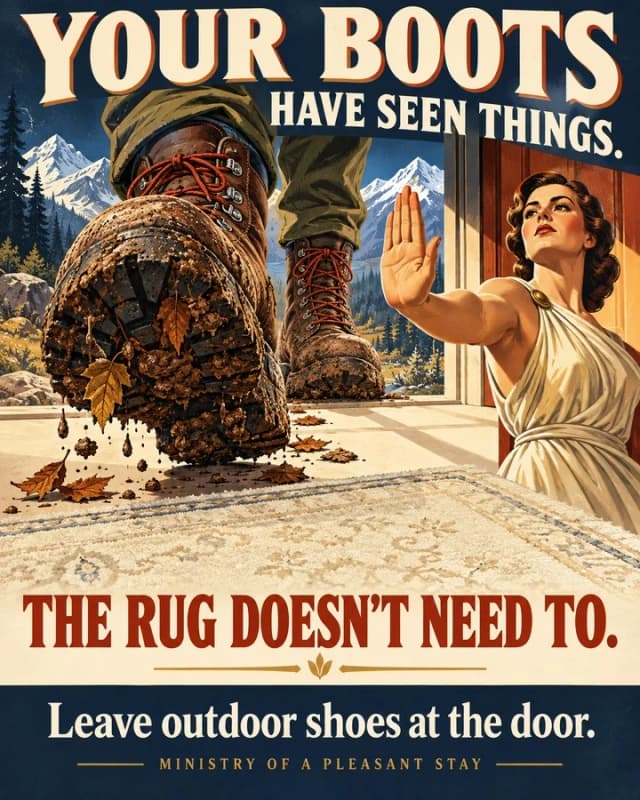
What to say: Shoes, sandy feet or muddy paws, if these matter at your property.
Where it goes: Beside the shoe rack, rinse station or pet-towel basket.
Give guests the thing they need to comply: a bench, mat, hose or clean towel.
What to say: What belongs in the toilet and which towels go outside.
Where it goes: Near the toilet-paper holder or towel shelf.
Keep a lined bin within reach. Make the instruction legible from a normal standing position.
What to say: A genuinely confusing appliance step or a simple trash reminder.
Where it goes: At the appliance or beside the bins.
Separate trash from recycling with clear labels. Put detailed appliance instructions in the manual.
What to say: Quiet hours or a no-smoking reminder, when useful.
Where it goes: One visible position in the shared space.
Use the same hours and policy as the listing. A poster is a reminder, not a surprise rule.
What to say: Beach-towel use, sand rinsing and unbreakable drinkware.
Where it goes: At the towel basket, rinse station and drinkware shelf.
Keep decorative reminders separate from required pool and emergency signage.
What to say: A short list and the exact place to return keys.
Where it goes: Beside the exit or key-return location.
Repeat the same instructions in the departure message. Avoid a second, longer checklist.
Humor can suit a low-stakes reminder about muddy boots or beach towels. Make the practical instruction just as clear as the joke. A guest should understand what to do even if the punchline doesn’t translate.
Use direct, plain language for emergency contacts, exits and safety information. Decorative posters should never take the place of required notices. For a property that hosts international travelers, pair short English instructions with a simple symbol or a translation you have checked.
For the Ministry artwork, 8 × 10 inches is a convenient starting point for a shelf or small wall position. Consider 16 × 20 inches when guests need to read from farther away. Check the smallest instruction text at the intended size and viewing distance before choosing a frame.
Start with matte paper to reduce glare. Review the printer’s crop preview, order one proof, and check both the illustration and small text in the room’s lighting. A high pixel count alone doesn’t guarantee a good result from every printer.
Write the policy once, then reuse it. If quiet hours change, update the listing, manual and any card that states the hours. Use our house-rules wording template for a short starting point and the house manual template for instructions that need more detail.
During a turnover, ask the cleaner to check that frames are readable, current and in the correct position. The turnover checklist is a useful home for that recurring task.